Published on Fri Apr 14 2023 09:20:00 GMT+0000 (Coordinated Universal Time) by Valerio Como
Angular Signals
A new reactive primitive

Want an AI-generated TL;DR? Open this page in Google Chrome to try the built-in AI summarization feature.
Are you a coding nerd? Check out this blog post;
Signals is a new primitive, which aims to handle asynchronous events and supports developers in adoptions of reactive patterns. It will be released with Angular 16 but it’s yet available through an unstable version of the package (16.0.0-next.0).
You may be wondering:
“is RxJs deprecated?”
The answer is simple: no.
Signals provide a straightforward approach to solve a similar problem. Take a look at this simple example.
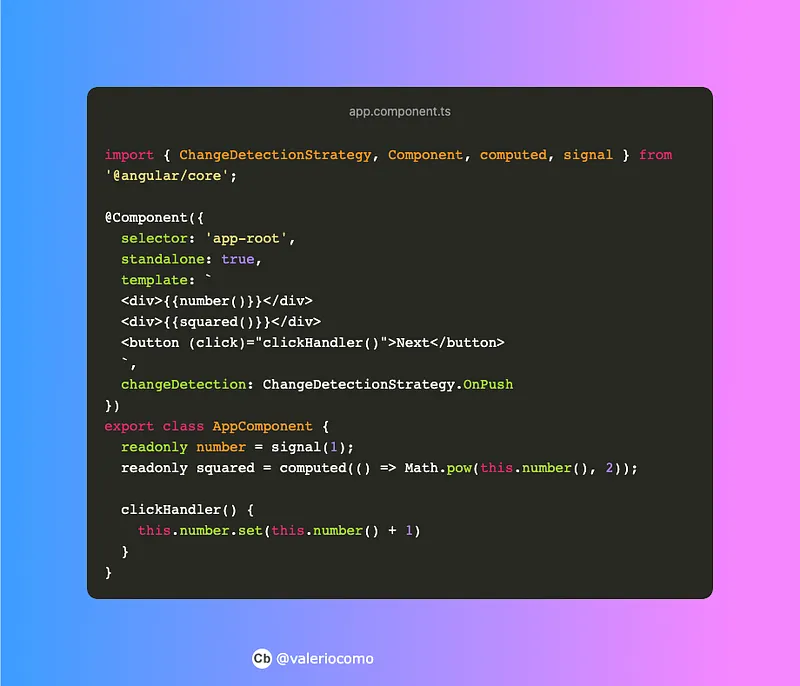
In this example, we have two variables: number and squared.
I set number to 1 with the primitive signal. Then, squared is assigned with compute and a callback as parameter. Every time number is updated, squared will be updated too. Simply as hell. No more RxJS to handle those kind of async events. It’s a blurry memory but it recalls signals and slots pattern of Qt.
As general statement, signals implements a producer/consumer pattern.
Why Signals?
The introduction of signals it’s the first step of a long-time change in Angular. ChangeDetection is the main topic and it’s related to the introduction of signals. Today, ChangeDetection is strictly bonded to zone.js. This lib is responsible for intercepting browser events and informs Angular that an event has been triggered. zone.js adoption has some advantages and some drawbacks.
ChangeDetection will be slightly different in the future with the adoption of signals. Components, as consumers, will be updated directly when a signal would produce a new value. It will be possible to avoid a complete check of the entire components tree, which is one of the main zone.js’ drawbacks.
Signals API
Signals introduces a list of new APIs.
signal(value)
Create a producer. It’s where everything starts.
set(value)
This API set a new value. It produces a new value for all the subscribers.
update(fn)
update takes a callback as argument. This function has a parameter and it represents the current value. It’s useful when you need to create a new value starting from the previous one. The function will return a new value. Function execution produces a new immutable value. update allows you to work with immutable values.
mutate(fn)
mutate allows you to update the current value as update do. But there is an important difference: its params function doesn’t return a value. You could create a new value starting from the previous one but without changing its reference. So, it’s not useful if you would work with immutable values.
computed(fn)
computed aims to derive or calculate a new value starting from a signal. It will run its callback when a new value is emitted.
effect(fn)
In the same way of computed, effect provide an API to consume produced values programmatically. Its callback is subscriber and it will be executed every time a new value is produced.
Interoperability
signals have to settle into a well-developed set of libraries. Some interoperability functions have been developed to interact with RxJS.
toObservable(signal)
Converts a signal into an observable.
toSignal(observable)
Converts an observable into a signal.
Other interoperability functions will be developed in the future. I would like to keep this list updated.
Conclusion
signals will be shipped with Angular 16 as a developer preview. This is first step in order to take zone.js away from Angular.
signals introduction is crucial because it enables a finer-grain Change Detection implementation. Due to this reason, It leads to an increase of performance.
The Angular development team, once again, was able to introduce this innovation without compromising the stability of the ecosystem. It’ll be very interesting to hear the first feedback from the developers. And you? What do you think? Leave a comment below!
EXTRA
Check out this repo on Github.
Written by Valerio Como
← Back to blog